Brioches
35 min
1 hour 30 min

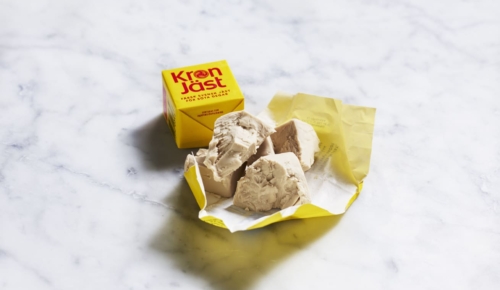
Yeast should not be frozen. If you want yeast with a longer shelf life, we recommend KronJäst dry yeast. Yeast is a single-celled living organism. When frozen, the cells can burst as the water inside them expands. This causes the cells to die and release enzymes that negatively affect the baking process. However, the yeast is safe to use even after freezing.
It’s possible to let dough ferment in the refrigerator for more than 12 hours without any problems; bakeries that use cold fermentation for their bread usually do this for about 18–20 hours. Time, temperature, handling, and the composition of the ingredients are the factors that influence the fermentation process in dough. It is therefore difficult to provide exact measurements and timing instructions without knowing these conditions. Yeast cells work more slowly in a cold environment so you’ll need to adjust the time and amount of yeast based on the parameters mentioned above.
Organic yeast requires a longer proofing time to achieve the same results as KronJäst for bread. We do not recommend using organic yeast for sweet doughs. We recommend extending the proofing time by about 30 minutes when baking unsweetened bread or everyday bread, and by at least 60 minutes when baking sweet doughs (more than 2.5 tablespoons of sugar per 14 deciliters of flour).
You can find KronJäst Sourdough at Mathem and in well-stocked ICA and Coop stores. If KronJäst Sourdough is not available or is out of stock at your store, please contact the category manager at your store—they’ll surely be happy to help. Unfortunately, we are unable to answer questions about individual stores’ product assortments.
Our products contain different yeast strains with different properties. Our Yeast for Bread has optimal leavening power in bread doughs because it easily absorbs maltose from the flour. However, it does not work as well in doughs with high fat and sugar content. Our Sweet Dough Yeast has optimal leavening power in sweet doughs and does not utilize maltose as quickly. Our Organic Yeast is produced from organic ingredients that are KRAV-certified and has optimal leavening power in bread doughs. Read more here.
Organic yeast requires a longer proofing time to achieve the same results as KronJäst for bread. We do not recommend using organic yeast for sweet doughs. We recommend extending the proofing time by about 30 minutes when baking unsweetened bread or everyday bread, and by at least 60 minutes when baking sweet doughs (more than 2.5 tablespoons of sugar per 14 deciliters of flour).
All yeast produced by KronJäst is made without palm oil.
Yeast is particularly rich in B vitamins. Below are general guidelines from the industry organization COFALEC regarding the nutritional content of baker’s yeast, dry, 95% dry matter.
| Nutrient | Contents | Unit |
|---|---|---|
| Energy Value | 360 | kcal/100 g |
| Protein | 43 | g/100 g dry weight |
| Fat | 5,7 | g/100 g dry weight |
| Carbohydrates | 19 | g/100 g dry weight |
| Potassium | 0.6–2.5 | g/100 g |
| Sodium | < 0,5 | g/100 g |
| Calcium | 0.02–0.15 | g/100 g |
| Magnesium | 0.03–0.25 | g/100 g |
| Iron | 0.001 - 0.1 | g/100 g |
| B1 | 2–15 | mg/100 g |
| B2 | 2–8 | mg/100 g |
| B6 | 0.5–6 | mg/100 g |
| Folic Acid | 1–4 | mg/100 g |
| Niacin | 10–60 | mg/100 g |
| Biotin | 0.05 - 0.25 | mg/100 g |
All yeast produced by Jästbolaget is completely GMO-free.
Common baker's yeast, Saccharomyces cerevisiae, is very easy to digest. Yeast is not included in the lists of products that cause allergies or intolerances subject to mandatory labeling under EU Regulation 1169/2011.
Yes, KronJäst products are Kosher-certified, with the exception of KronJäst Whole-Grain Wheat Sourdough and KronJäst Rye Sourdough.
You can find KronJäst Sourdough at Mathem and in well-stocked ICA and Coop stores. If KronJäst Sourdough is not available or is out of stock at your store, please contact the category manager at your store—they’ll surely be happy to help. Unfortunately, we are unable to answer questions about individual stores’ product assortments.
Organic yeast requires a longer proofing time to achieve the same results as KronJäst for bread. We do not recommend using organic yeast for sweet doughs. We recommend extending the proofing time by about 30 minutes when baking unsweetened bread or everyday bread, and by at least 60 minutes when baking sweet doughs (more than 2.5 tablespoons of sugar per 14 deciliters of flour).
Through fermentation, the yeast brings out the food's characteristic flavor and aroma.
Yeast contributes to the characteristic rich flavor of bread, sandwich bread, and wheat bread, as the fermentation process naturally produces aromatic compounds (such as esters). The longer the fermentation, the more flavors develop.
KronJäst sourdough is intended for use immediately after opening. If the sourdough bag has been properly sealed and no utensils have been used inside it, it may be possible to store it for a few days.
Sourdough should not be frozen. Freezing has a negative effect on its activity. As a living product, freezing creates conditions that are unfavorable for the microorganisms, and the ice crystals that form can kill the cells. However, sourdough is safe to use after freezing.
It is an active rye sourdough and whole-wheat sourdough, respectively.
You can find KronJäst Sourdough at Mathem and in well-stocked ICA and Coop stores. If KronJäst Sourdough is not available or is out of stock at your store, please contact the category manager at your store—they’ll surely be happy to help. Unfortunately, we are unable to answer questions about individual stores’ product assortments.
Gas forms naturally because sourdough is a living product. If the valve on the back of the bag isn’t working properly, the gas cannot escape, resulting in swollen sourdough bags. Despite this, the sourdough is still perfectly fine to use.
No, under normal circumstances, this shouldn't happen. To prevent the bags from swelling, store the sourdough upright so that the valve on the back doesn't get blocked. Don't place anything on top of a swollen bag, as there is a risk it might burst—for example, don't put it at the bottom of your grocery bag.
We recommend adding a little yeast to achieve the best possible baking results. It can certainly work without it, but the yeast ensures that you get consistently good results every time and that the bread is guaranteed to rise properly—this applies both to our sourdough starter and if you’ve made your own. Sourdough contains plenty of yeast that comes naturally from the flour, but the yeast strain in sourdough is not the same as the yeast you bake with from KronJäst (Saccharomyces cerevisiae) and therefore does not have the same leavening power.
Store it upright in the refrigerator at a maximum temperature of +6°.
The sourdough is in a dormant phase, and gas production is at a low level. When the sourdough comes into contact with flour, water, and heat, the process starts again. Our sourdough is not intended for use as a sourdough starter but is meant to be used in baking, together with yeast.
By keeping it in constant cold storage and ensuring a high level of cleanliness during packaging, the microorganisms go into a “dormant” state because there is very little available nutrition. When the product then comes into contact with flour, water, and heat, the process starts again. Our sourdough is not intended for use as a sourdough starter but is meant to be used in baking, together with yeast.
Our sourdough starter is not designed to be used as a sourdough base; rather, it is intended for use in baking, along with yeast. If you want to use it as a sourdough base, you can, but you’ll need to feed it for several days before it becomes active.